Within this submission we were tasked with creating our own patches that would replicate certain instruments or carry out a particular function as an introduction to the world of modular synthesis. The first of these modular synthesis patches was based around tuning two oscillators together. Below, an image has been included showing the patch that was created for this task.
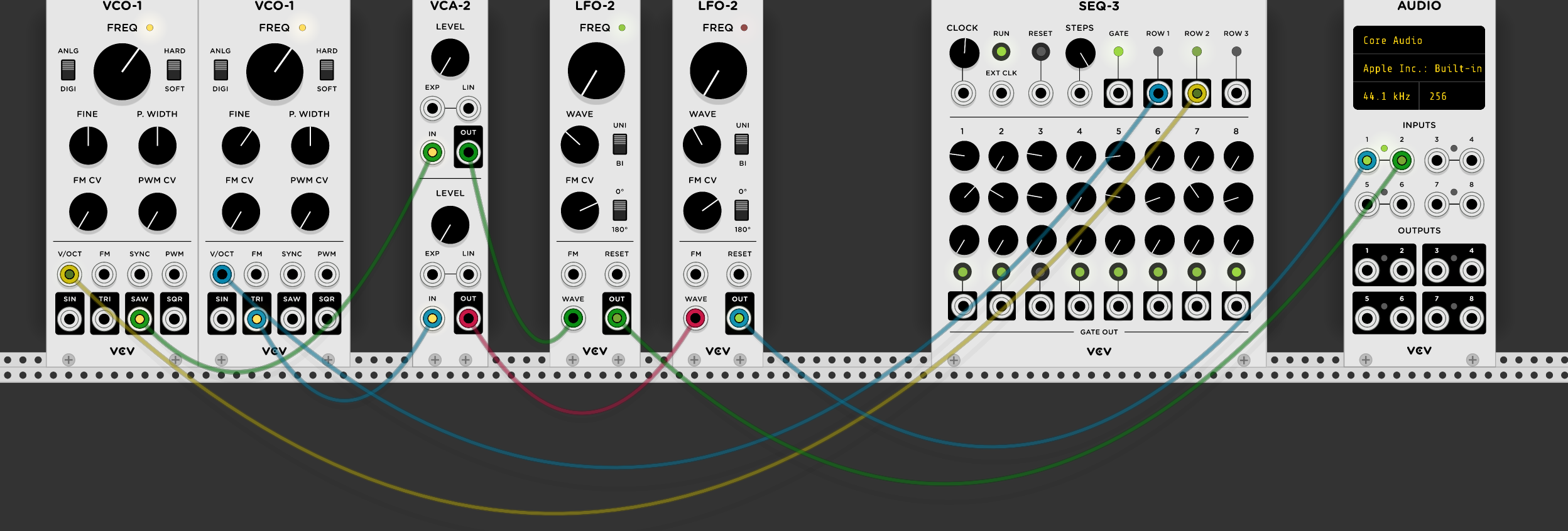
After attempting to tuning both voices together using the frequency dial, I could hear that they were slightly out of phase, I then adjusted the fine tune dial until they were perfectly in tune. Alongside tuning the two oscillators a small composition was to be put together to demonstrate the capabilities of the patch. An ambient drone was recorded simply using by the tuned oscillators with a small amount of reverb applied within logic, this was used as the backbone of the composition. As the tuned voice of both oscillators was used for this background drone, I decided to separate the two voices within the SEQ-3 sequencer module to create a basic melody. Rows one and two of the sequencer were patched to the one volt per octave of each VCO individually, this allowed for each voice to be controlled seperately by the eight dials of each row. To add a little more variety to the sound of the composition the signal of each oscillator was passed through an LFO module, allowing for small adjustments to be made to the voices throughout the recording.
The second patch that was created for this submission was based around envolopes, below, an image has been included showing the patch that was created for this task.

The composition created for this task was used to demonstrate the function of an envelope within a modular patch. Similarly to the previous example, the voices of two oscillators were passed through a sequencer playing a looped melody. This basic sequence allowed me to experiment with the attack, decay, sustain and release perimeters of the envelope modules that the signal was passing through while recording into logic. For this composition, a saw and triangle wave were used to see what different kinds of effect the ADSR would have on these waveforms. This gave me a better understanding of how the envelope module could be used to produce certain sounds and effects that i could use in the future within my compositions.
For the third patch within this submission, we were tasked with recreating an instrument using modular synthesis. I decided to produce a kick drum as this is the one instrument i could create using modular synthesis that i could see myself having a real use for within my music aside for the more stereotypical sounds of synthesis. Below, an image has been included showing the patch that was created for this task.

Unlike the previous two examples, the sequencer here is used to trigger the envelopes within the patch, it also ensures that the signal from the VCO hits like a kick drum as oppose to a constant note. A voltage controlled filter was also used within this patch as it has a low pass filter output built into it, this means that when the signal passes through this module any high frequencies will be filtered out. Alongside this, the frequency of the VCO has been turned down relatively low as well a sine wave being used to recreate those low bass frequencies. Within this patch, the ADSR module on the left provides the thumping bass tone while the output of the ADSR or the right is patched into the one volt per octave input of the oscillator, this provides the click of the pedal initially hitting the drum. While the patch sounded of something that resembled a kick drum without this addition, I fell that the click of the initial drum hit adds a layer of realism to the patch.
For the final task of this submission, we were tasked with creating a drone piece within a modular patch. With the Buchla being the weapon of choice for many when thinking of drone compositions, I wanted to see what could be done within VCV rack, layering up modules to feedback through each other to see how close I could get to that iconic Buchla sound. Below an image has been included showing the patch that was created for this task.

A big factor in achieving a sound as close to the Buchla as possible was the use of FM synthesis, in the image above you can see that I have used the sine wave of an LFO module to modulate the sine wave output of the VCO, it is this distinctive sound that I feel helped push the sound of this drone patch towards the sound of the Buchla. Despite striving for a unique self generative sound I have used a sequencer within this patch, I landed on this decision as i wanted a variety of notes to blend together through a fast clock speed and a large number of LFO frequencies and delays battling for dominance in the mix. Although I started the patch with pre determined notes on the sequencer, the feedback loop created meant that the patch would morph and progress if left to its own devices.

 Music and Sound Synthesis CT6MASS