Within this submission we were tasked with creating our own modular synthesiser using modular grid. I decided that my modular rack would be used to create ambient music as this is a genre of music that involves a very relaxing and smooth style of synthesis that I not only listen to but produce at home. Although the synthesis within ambient music can often times been seen as quiet simple, I decided to set my budget at £3000. This budget allowed for more choice in higher quality modules as well as the option to include two rows. Alongside the aim of creating ambient music for recording, the inclusion two rows and the option of utilising a fair few modules in my rack meant that it had more versatility when it comes to live performance as well. This choice would open up options within a career in the music industry, not only as a producer, but as a performing artist.
Below an image has been included showing the modular synthesiser I put together using modular grid, as well as a link to view it on the website itself.
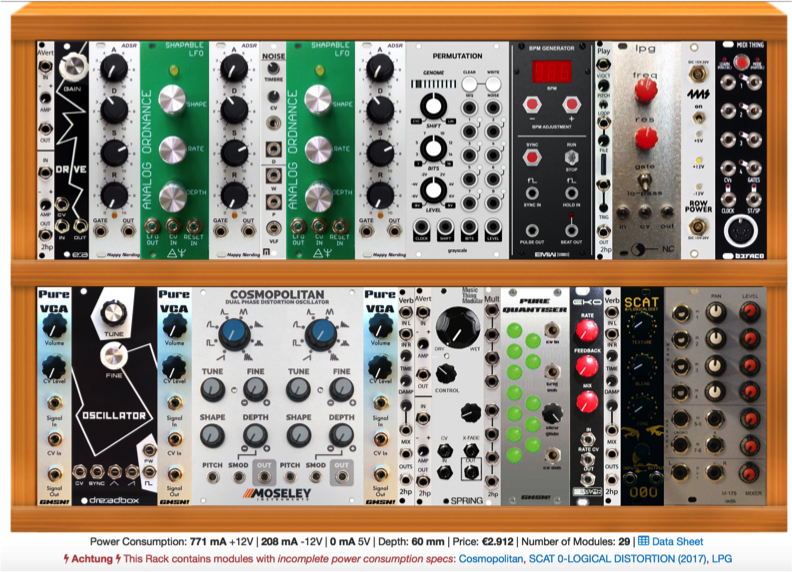
When designing this modular synthesiser I took great inspiration from artists like Martin Stürtzer and Patrick O’Brien who are both artists i discovered through youtube’s music section. Both of these artists post full live sets on their channels to show what can be done with modular synthesis when it comes to ambient music in a live environment. Using a mixture of built in sequencers within the rack as well as a few pre recorded modular samples triggered through external sample pads, they are able to improvise and produce music on the spot purely through the knowledge of their modular rack. With this is mind i set out to design my rack so that it may be put to similar use.
Similarly to that of my drone patch design within the weekly task submission I pushed the design of my synthesiser towards producing tones and voices that would easily feedback and play off of one another, in this instance using reverb, delay, noise and distortion modules. It was my hope that using these modules twinned with the GMSN Pure Quantiser Sequencer would mean a droning loop could be created while parameters on modules such as the analogue ordnance shapable LFO, Happy Nerding ADSR and the Nonlinearcircuits low pass gate could be adjusted over time to create the kind of haunting ambient melodies and overtones that Martin Stürtzer and Patrick O’Brien create within their music. The Befaco MIDI Thing is another module that opens up a huge realm of possibilities for this synthesiser. As a midi to CV converter, this module would allow me to connect my midi keyboard, external sequencer, drum machine or sample pad to the synthesiser which would all be of great use in a live environment. Using a keyboard or drum machine would allow for a VCO to be playing through a sequencer while a separate VCO is being controlled externally either by playing chords or a melody live, or programming in more loops through external sequencers.
The cosmopolitan oscillator is another module that I feel is important to the design of this rack as it provides two oscillators that can be used simultaneously as well as the option to switch between 8 different wave forms. Not only would this be useful when thinking about ambient music but this module alone opens up opportunities for this system to branch out into other styles and genres with its wide range of sound capabilities.
Another huge influence on the design of this synthesiser is Alessandro Corsini of Nine Inch Nails as his use of droning ambient sounds adds additional layers and depth to the bands music during live sets as well as recordings, his use of a volume pedal allows him to bring the synthesiser in and out of the mix when it is needed in particular songs. Despite his use of Buchla type modules as well drum sequencers I feel that his ambient tones specifically are similar to what I was aiming for with this design. Bellow I have included a link to a rundown of his live rig that I took a lot away from when thinking about live performance with modular synthesisers. https://www.youtube.com/watch?v=MMXEvNUjgCg

 Music and Sound Synthesis CT6MASS